Gold, a timeless symbol of wealth and stability, continues to captivate investors worldwide. Its price fluctuates daily, influenced by a complex interplay of economic, geopolitical, and market forces. Understanding these dynamics is crucial for anyone considering gold as an investment or simply curious about its current market standing. This comprehensive analysis delves into the current gold price, exploring its recent performance, influencing factors, and potential future trajectories.
We’ll examine various investment strategies, compare gold with other precious metals, and consider its significant role in the global economic landscape.
From examining historical price performance and identifying key factors affecting gold’s value to exploring diverse investment options and considering its role as a safe haven asset, we aim to provide a well-rounded perspective on this precious metal’s current state and future prospects. This analysis will empower you to make informed decisions regarding gold, whether as an investor, a curious observer, or simply someone interested in the intricacies of global finance.
Historical Gold Price Performance
Gold’s value has fluctuated considerably over time, influenced by a complex interplay of economic, geopolitical, and market factors. Understanding past performance provides valuable context for interpreting current trends and making informed decisions about potential investments. This section will analyze gold’s price movements over the past year and compare them to longer-term averages.
Analyzing historical gold price data reveals important trends and patterns. Visual representations, such as charts, offer a clear and concise summary of these fluctuations. A comprehensive understanding of these historical movements helps investors gauge potential risks and returns.
Gold Price Performance Over the Past Year
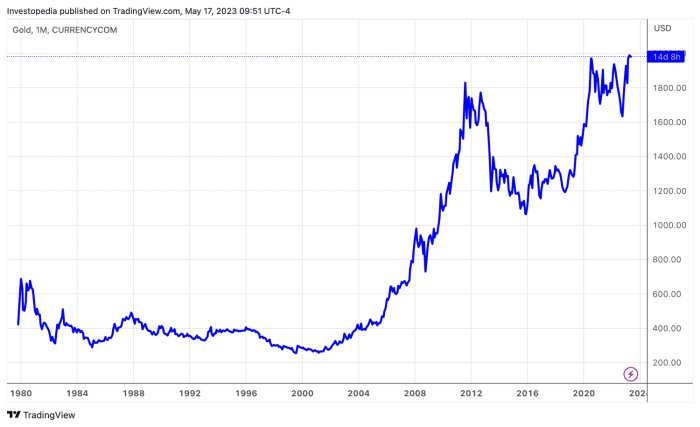
Imagine a line graph charting gold prices over the past 365 days. The x-axis represents time, progressing from the earliest date to the most recent. The y-axis displays the gold price, likely in US dollars per troy ounce. The line itself would show the daily closing price, rising and falling to reflect market activity. Key features might include periods of sustained upward or downward trends, perhaps reflecting periods of economic uncertainty or stability.
Sharp, sudden spikes or drops could highlight specific events, such as major geopolitical announcements or significant changes in monetary policy. For example, a sudden drop might correspond to a period of increased investor confidence in other asset classes. Conversely, a sharp rise could reflect a flight to safety during times of economic turmoil.
Highest and Lowest Gold Prices in the Past Year
The highest gold price recorded in the past year was [Insert Highest Price] per troy ounce on [Insert Date]. Conversely, the lowest price reached was [Insert Lowest Price] per troy ounce on [Insert Date]. These peaks and troughs represent the extremes of price volatility during this period. The difference between these two values provides a measure of the price range experienced throughout the year.
These data points are crucial for assessing the risk associated with gold investments over the specified timeframe.
Comparison of Current Gold Price with Past Averages
Comparing the current gold price to its average over longer periods offers valuable perspective on its recent performance relative to its historical trend. This comparison helps determine if the current price represents an overvaluation or undervaluation compared to longer-term averages.
- Current Gold Price: [Insert Current Price] per troy ounce.
- Five-Year Average Gold Price: [Insert Five-Year Average Price] per troy ounce. This average reflects the mean price over the past five years, smoothing out short-term fluctuations to reveal a longer-term trend.
- Ten-Year Average Gold Price: [Insert Ten-Year Average Price] per troy ounce. This average provides an even broader perspective, encompassing a longer period of economic and geopolitical events.
Factors Affecting Gold Prices
Gold’s price, seemingly volatile at times, is actually influenced by a complex interplay of economic and geopolitical factors. Understanding these influences is crucial for anyone interested in investing in or simply following the precious metal market. This section will explore three key factors: inflation, interest rates, and currency fluctuations.
Inflation’s Influence on Gold Prices
Inflation, the persistent increase in the general price level of goods and services, often has a positive correlation with gold prices. When inflation rises, the purchasing power of fiat currencies decreases. Gold, a tangible asset with a limited supply, is often seen as a hedge against inflation. Investors seek refuge in gold as a store of value, driving up demand and consequently, its price.
For example, during periods of high inflation, such as the 1970s, gold prices experienced significant increases. Conversely, periods of low inflation can lead to a decreased demand for gold, potentially resulting in lower prices. The relationship, however, is not always perfectly linear; other factors can also influence the gold price simultaneously.
Interest Rates and Gold Prices
Interest rates and gold prices typically exhibit an inverse relationship. Higher interest rates generally lead to lower gold prices. This is because higher interest rates increase the opportunity cost of holding non-interest-bearing assets like gold. Investors might find it more attractive to invest in interest-bearing assets like bonds, which offer a return, instead of gold, which offers no yield. Conversely, lower interest rates can make gold a more attractive investment, as the opportunity cost of holding it decreases.
For instance, during periods of quantitative easing (like the post-2008 financial crisis), when interest rates were exceptionally low, gold prices saw a considerable surge.
Impact of Currency Fluctuations on Gold Prices
Gold is often priced in US dollars. Therefore, fluctuations in the US dollar’s value significantly impact gold prices. A stronger US dollar typically leads to lower gold prices, as it becomes more expensive for holders of other currencies to buy gold. Conversely, a weaker US dollar generally leads to higher gold prices, making it more affordable for international investors.
This is because the demand for gold increases as its price in their local currency falls. For example, a weakening dollar might boost gold prices in Euros or Yen, prompting increased buying pressure and pushing up the dollar-denominated price of gold.
Gold Investment Strategies
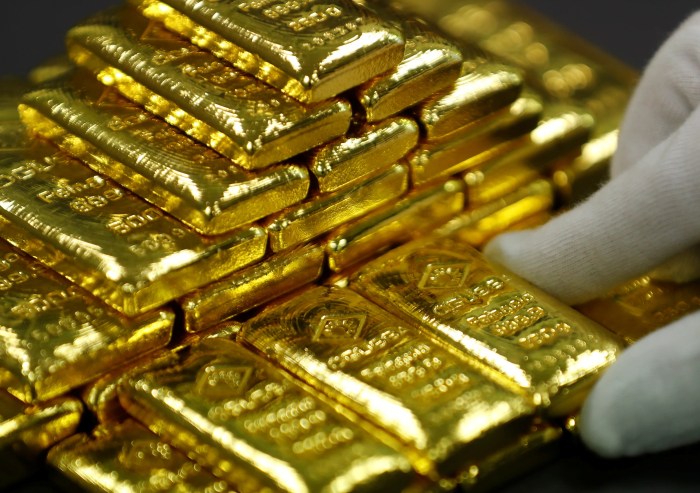
Investing in gold offers a diverse range of options, each with its own set of advantages and disadvantages. Understanding these nuances is crucial for building a well-diversified portfolio and achieving your financial goals. The choice of investment strategy depends heavily on your risk tolerance, investment timeline, and overall financial objectives.
Several avenues exist for incorporating gold into your investment portfolio. Each method presents a unique blend of risk and reward, requiring careful consideration before committing capital.
Gold Investment Options
Investors can access the gold market through various channels, each offering a distinct approach to gold ownership and exposure.
- Physical Gold: This involves directly owning gold in the form of bars, coins, or jewelry.
- Gold ETFs (Exchange-Traded Funds): These funds track the price of gold, allowing investors to buy and sell shares representing a fraction of gold ownership without the hassle of physical storage.
- Gold Mining Stocks: Investing in companies that mine and produce gold offers exposure to the gold market, but also introduces additional company-specific risks.
Risk and Benefit Analysis of Gold Investment Strategies
A thorough understanding of the risks and benefits associated with each gold investment strategy is essential for making informed decisions.
| Advantages |
Disadvantages |
Physical Gold
Tangible asset; Hedge against inflation; Relatively low transaction costs (depending on purchase method); Potential for numismatic value (collectible coins). |
Physical Gold
Storage costs and security concerns; Liquidity can be an issue; Vulnerable to theft or damage; Price volatility. |
Gold ETFs
Easy to buy and sell; Diversification benefits; Lower storage and security costs compared to physical gold; Transparency and regulatory oversight. |
Gold ETFs
Exposure to market risks; Management fees; Price volatility; Potential for counterparty risk (though usually mitigated by reputable fund managers). |
Gold Mining Stocks
Potential for high returns; Leverage to gold price movements; Diversification beyond just gold price (company performance factors in). |
Gold Mining Stocks
High risk; Subject to company-specific risks (management, operational, financial); Price volatility amplified by market sentiment and company performance; Less liquid than ETFs or physical gold. |
Precious Metals
Gold often takes center stage in precious metal discussions, but silver, platinum, and palladium also experience significant price fluctuations and hold considerable economic importance. Understanding their individual price movements and relationships with gold provides a more comprehensive perspective on the precious metals market.Silver, platinum, and palladium frequently exhibit price correlations with gold, though the strength and direction of these relationships can vary considerably over time.
While often moving in tandem during periods of general market uncertainty or inflation, their individual industrial uses and supply dynamics can lead to divergences. For example, strong industrial demand for platinum and palladium, particularly in the automotive sector for catalytic converters, can decouple their prices from gold’s performance, even during periods of gold price increases. Similarly, silver’s use in photography, electronics, and solar energy can influence its price independently of gold.
Properties and Uses of Precious Metals
Gold, silver, platinum, and palladium each possess unique physical and chemical properties that dictate their respective applications. Gold, prized for its malleability, ductility, and resistance to corrosion, is primarily used in jewelry, investment, and electronics. Silver, also highly conductive, finds extensive use in electronics, photography, and industrial applications. Platinum and palladium, known for their high melting points and catalytic properties, are crucial in the automotive industry (catalytic converters) and jewelry.
These distinct properties and uses lead to differing market dynamics and price sensitivities to various economic factors.
Factors Influencing Precious Metal Prices
Several factors influence the prices of silver, platinum, and palladium, often overlapping with, but not always mirroring, those affecting gold. Industrial demand plays a crucial role, especially for platinum and palladium, with automotive production cycles significantly impacting their prices. Investment demand, similar to gold, can drive price increases, particularly during periods of economic uncertainty. Supply-side factors, including mining output, geopolitical events affecting production regions, and recycling rates, also exert considerable influence.
Currency fluctuations and inflation also impact the prices of all precious metals, but the degree of impact varies depending on the specific metal and prevailing market conditions. For instance, a weakening US dollar tends to boost the prices of all precious metals, as they are often priced in dollars, making them more attractive to international buyers. However, the magnitude of this effect is not uniform across all four metals.
Gold’s Role in Global Economics
Gold’s position in the global economy extends far beyond its use in jewelry and electronics. Its inherent properties, particularly its scarcity and perceived stability, have cemented its role as a crucial element in international finance and a significant factor influencing global economic trends. This section will explore gold’s multifaceted influence on the world’s economic landscape.Gold’s function as a safe haven asset is deeply rooted in its historical stability and lack of correlation with other asset classes.
During periods of economic uncertainty, such as financial crises or geopolitical instability, investors often flock to gold as a store of value. This increased demand drives up the price, reflecting a flight to safety as investors seek to preserve capital amidst market turmoil. For example, during the 2008 financial crisis, gold prices surged significantly as investors sought refuge from the collapsing global financial system.
This demonstrates gold’s capacity to act as a hedge against systemic risk.
Gold in Central Bank Reserves and Monetary Policy
Central banks worldwide hold substantial gold reserves, representing a significant portion of their foreign exchange reserves. These reserves serve as a buffer against economic shocks and currency fluctuations. The presence of gold in a nation’s reserves can enhance its credibility and stability in the global financial system, providing a level of confidence to international investors and lenders. Changes in central bank gold holdings can signal shifts in monetary policy and influence global currency markets.
For instance, a significant increase in gold purchases by a major central bank could indicate a concern about the stability of the global financial system and might even trigger a shift towards a more conservative monetary policy approach globally. The actions of central banks regarding gold demonstrate the metal’s continued relevance in the international monetary system.
Impact of Gold Production on Global Economies and Environmental Considerations
Gold mining significantly impacts both global economies and the environment. Gold production contributes to the GDP of many countries, providing employment and revenue through mining operations, refining, and related industries. However, gold mining is often associated with significant environmental challenges. These include habitat destruction, water pollution from cyanide and mercury used in extraction, and greenhouse gas emissions from energy-intensive mining processes.
The environmental impact of gold mining is a growing concern, leading to increasing pressure on the industry to adopt more sustainable practices. For example, the increasing popularity of responsible sourcing initiatives and the demand for ethically mined gold reflect a growing awareness of the environmental and social costs associated with gold production. Balancing the economic benefits of gold mining with the need for environmental protection presents a significant challenge for governments and the mining industry alike.
Future Gold Price Predictions (Qualitative)
Predicting the future price of gold is inherently challenging, as it’s influenced by a complex interplay of economic, geopolitical, and market factors. While precise numerical forecasts are unreliable, analyzing prevailing trends and expert opinions offers valuable insights into potential price movements. This section explores various scenarios that could significantly impact gold’s value in the coming years.Experts generally agree that several factors will shape gold’s future trajectory.
These factors, however, can interact in unpredictable ways, making definitive predictions impossible. Instead of focusing on specific numbers, a qualitative assessment focusing on potential upward and downward pressures proves more useful.
Potential Drivers of Gold Price Increases
Several scenarios could lead to substantial increases in gold prices. These scenarios often involve heightened uncertainty and a flight to safety.
- Increased Geopolitical Instability: Escalating international tensions, wars, or major political upheavals often drive investors towards safe-haven assets like gold, boosting demand and prices. The ongoing conflict in Ukraine serves as a recent example, demonstrating how geopolitical uncertainty can significantly impact gold’s value.
- Inflationary Pressures: Persistent high inflation erodes the purchasing power of fiat currencies, making gold, a tangible asset with inherent value, an attractive hedge. Periods of high inflation, such as those experienced in the 1970s, often correlate with significant increases in gold prices.
- Weakening US Dollar: Gold is priced in US dollars. A decline in the dollar’s value relative to other currencies can make gold more affordable for international investors, increasing demand and driving up prices.
- Central Bank Demand: Central banks globally are increasingly diversifying their reserves, adding gold to their portfolios as a hedge against economic and geopolitical risks. Increased central bank purchases can significantly impact overall gold demand.
Potential Drivers of Gold Price Decreases
Conversely, certain factors could exert downward pressure on gold prices. These scenarios often involve improved economic conditions and reduced investor anxiety.
- Rising Interest Rates: Higher interest rates generally increase the opportunity cost of holding non-yielding assets like gold, as investors can earn higher returns on interest-bearing instruments. This can lead to decreased gold demand and lower prices.
- Stronger US Dollar: A strengthening US dollar can make gold more expensive for international investors, potentially reducing demand and lowering prices.
- Improved Global Economic Outlook: Periods of robust global economic growth and stability often reduce the demand for safe-haven assets like gold, as investors shift towards riskier, higher-return investments.
- Technological Advancements in Mining: Improvements in gold mining technology can lead to increased supply, potentially putting downward pressure on prices if demand remains relatively stable.
Hypothetical Geopolitical Impact Scenario
Imagine a major escalation of tensions between two significant global powers, leading to widespread uncertainty in the financial markets. This could trigger a rapid flight to safety, with investors massively increasing their gold holdings. The resulting surge in demand would likely outweigh any increase in supply, causing a significant and potentially rapid increase in gold prices. The 2008 financial crisis, while not solely driven by geopolitical events, provides a relevant example of how market uncertainty can dramatically impact the price of gold, as investors sought the safety and stability of the precious metal.
A similar, but more acute, scenario involving major geopolitical upheaval could easily replicate, or even surpass, the price increases seen during that period.
In conclusion, the gold market presents a dynamic and multifaceted landscape. While predicting future prices with certainty remains impossible, understanding the interplay of economic indicators, geopolitical events, and investor sentiment is crucial for navigating this market effectively. Whether you’re considering gold as a hedge against inflation, a diversification strategy, or simply a fascinating element of global finance, a thorough understanding of its current state and potential future movements is paramount.
This analysis serves as a starting point for your own exploration of this compelling and enduring market.
Frequently Asked Questions
What are the primary risks associated with investing in physical gold?
Primary risks include storage costs, security concerns (theft or loss), and potential price volatility.
How do I buy gold ETFs?
Gold ETFs can typically be purchased through a brokerage account, similar to buying stocks.
What is the difference between gold and gold mining stocks?
Gold directly represents ownership of the physical metal, while gold mining stocks represent ownership in companies that extract gold. Their prices are not directly correlated.
Where can I find reliable, up-to-the-minute gold price information?
Reputable financial news websites and trading platforms offer real-time gold price data.

